What the Trash Truck Taught Him: The Unlikely Eye Behind America's Most Celebrated Landscapes
What the Trash Truck Taught Him: The Unlikely Eye Behind America's Most Celebrated Landscapes
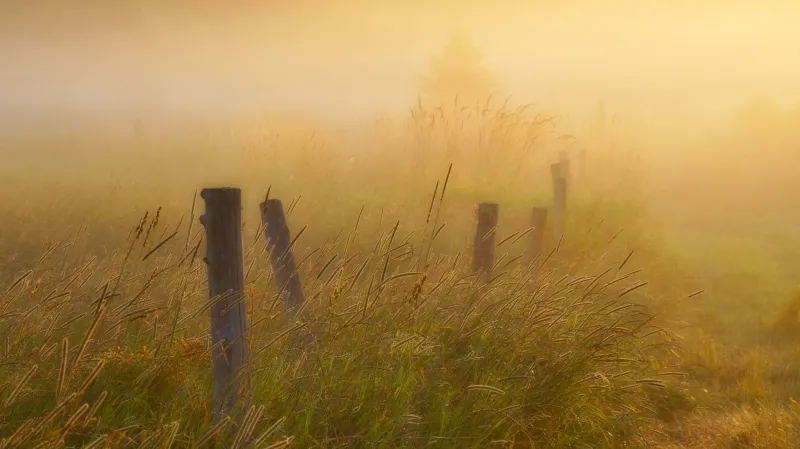
There's a painting hanging in the permanent collection of the Smithsonian American Art Museum that stops people cold. It's a simple scene — a gravel road cutting through a flat Tennessee field at dusk, the light going copper and strange, the kind of moment most people blink past on their way somewhere else. Critics have described it as "quietly devastating." One reviewer called it "the most honest American landscape painted in the last thirty years."
 Photo: Smithsonian American Art Museum, via a.travel-assets.com
The man who painted it spent the three decades before he touched a canvas hauling other people's garbage.
The Long Education Nobody Called an Education
Earl Dupree grew up in Hardin County, Tennessee, the second of five kids, and left school at sixteen to help his family. By nineteen, he was driving a municipal waste truck for a small county operation that covered rural routes — the kind of routes that take you down roads with no names, past farms where the mailbox is the only sign of life, through landscapes that look like they've been quietly waiting for someone to notice them.
 Photo: Earl Dupree, via www.americustimesrecorder.com
He did that for thirty-one years.
And here's the thing about driving a garbage route through rural America: you see everything. You're up before the light changes. You watch seasons arrive and leave from the same stretch of road, year after year. You notice the way a particular stand of trees looks in February fog versus October frost. You develop an almost involuntary intimacy with overlooked places — the back sides of fields, the margins of small towns, the spots where civilization just kind of trails off into something older and quieter.
Dupree didn't know he was building a visual library. He thought he was just doing his job.
Fifty-Three and Starting Over
He picked up his first set of oil paints at fifty-three, after a minor health scare that left him with six weeks of medical leave and absolutely nothing to do. His daughter had left an old beginner's kit in the garage. He set it up on the kitchen table, watched a few tutorials online, and painted what he knew: a drainage ditch off Highway 64 that he'd driven past roughly eleven thousand times.
It was rough. He knew it was rough. But something in the composition was undeniably right — the weight of the sky, the way the water caught a particular quality of afternoon light. His daughter showed it to a friend who taught art at a community college in Memphis. That friend called it "structurally confident in a way that takes most students years to develop."
Dupree kept going. He painted on weekends, then evenings, then every spare hour he could find. He wasn't painting from imagination or reference photos. He was painting from thirty years of accumulated looking — from a mental catalogue of scenes that no formally trained painter had ever bothered to document, because formally trained painters weren't out there at 5 a.m. in February watching the mist sit on a soybean field.
The Vantage Point That Changed Everything
What separates Dupree's work from the crowded field of American landscape painting isn't technical virtuosity — he'd be the first to tell you his brushwork is self-taught and imperfect. What separates it is specificity. His paintings show you places that feel like they've never been painted before, because they genuinely haven't. The rural South he captured wasn't the romantic, soft-focus version that appears in galleries. It was the version you see from a truck cab: functional, unsentimental, unglamorous, and somehow more beautiful for all of that.
Art historians have a term for the phenomenon — "outsider perspective" — though Dupree bristles at the label. "Outsider to what?" he said in a 2019 interview. "I was more inside those landscapes than anybody. I was there every single morning."
He has a point. The formal art world tends to treat unconventional backgrounds as charming footnotes to an artist's story. What it misses is that those backgrounds are often the story itself. Dupree didn't succeed despite his decades on a garbage route. He succeeded because of them.
From the Truck to the Gallery Wall
His first real exhibition came in 2011, at a small gallery in Nashville that specialized in regional artists. It sold out in a weekend. A write-up in a local arts magazine caught the attention of a curator at the Tennessee State Museum, who offered him a solo show. That show traveled. By 2015, his work was appearing in group exhibitions alongside artists with MFAs from Yale and RISD — artists who had spent their twenties in studios while Dupree was spending his on a county waste route.
He retired from waste management in 2016, at sixty-one. He now paints full-time from a converted barn outside Savannah, Tennessee, about twelve miles from the routes he drove for three decades. He still wakes up before dawn. Old habits.
What He Left Behind — and What He Kept
There's a tendency, in stories like this, to frame the early years as wasted time — as a detour before the real life began. Dupree refuses that framing entirely. He talks about his years on the truck the way other artists talk about their training, because for him, that's exactly what it was.
"People ask me where I studied," he said. "I tell them: Hardin County. Decatur County. McNairy County. Every back road between here and the Mississippi state line. That was my school."
The curriculum was thirty-one years of early mornings, overlooked ditches, and a windshield full of light that nobody else thought was worth watching. Turns out, it was worth everything.