Gold on the Outside, War on the Inside: Five Olympians Who Won While Fighting Their Darkest Battles

The Olympics sells us a story we can't resist. The pure athlete. The years of sacrifice. The single shining moment when everything clicks and a human being becomes, briefly, the best in the world at one specific thing. It's a beautiful story. It's also, for many of the people living it, only part of the truth.
Behind a surprising number of Olympic medals — gold ones, famous ones, the kind that end up in documentaries and motivational posters — there were private battles that the athletes carried onto the field, into the pool, down the track, and somehow, improbably, across the finish line first. These are five of those stories.
1. Dick Howard — Rome, 1960
Dick Howard won a bronze medal in the 400-meter hurdles at the 1960 Rome Olympics, one of the most competitive field events of the era. He was 22 years old, fast, and by all outward appearances, a young man with everything ahead of him.
 Photo: Dick Howard, via s.france24.com
What his teammates and coaches didn't know — what almost nobody knew — was that Howard had been struggling with heroin addiction for years before Rome. He had started using as a teenager in Los Angeles, moving through a world where the drug was quietly devastating communities that the mainstream press wasn't paying much attention to. He trained through it, competed through it, and stood on an Olympic podium through it.
Howard died of a heroin overdose in 1967, seven years after Rome, at age 27. His story — the medal, the addiction, the gap between them — only became widely known decades later, when journalists and historians began revisiting the lives of athletes who had competed in that era. What it reveals is not a failure of character but something more complicated: a young man who found, in competition, one of the only places where the noise in his head went quiet.
2. Betty Cuthbert — Melbourne, 1956 / Tokyo, 1964
Betty Cuthbert was Australia's golden girl, a sprinter who won three gold medals at the 1956 Melbourne Games and then, after years of injury and what she later described as profound emotional darkness, came back to win a fourth gold at Tokyo in 1964. The comeback story was celebrated worldwide. The private story was considerably harder.
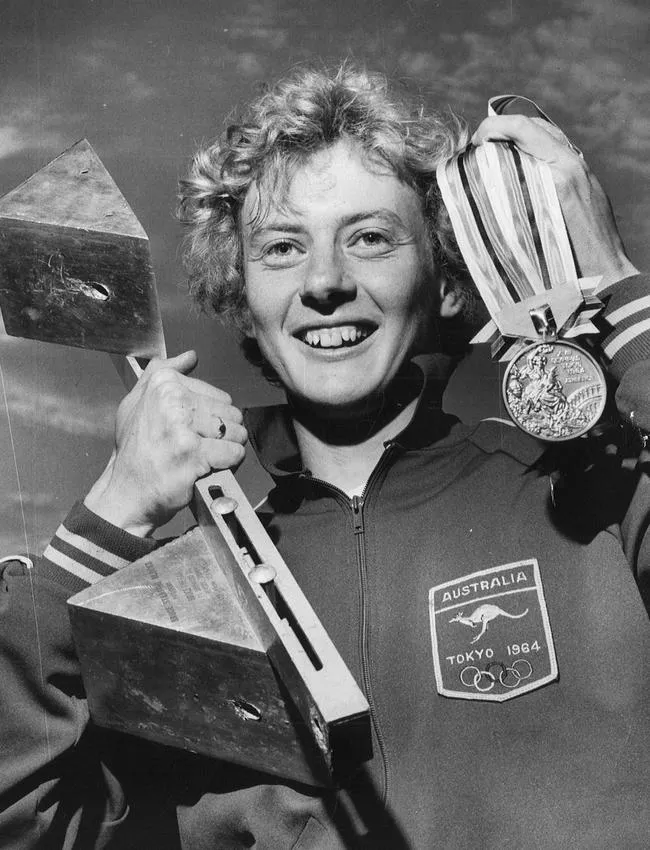 Photo: Betty Cuthbert, via content.api.news
Cuthbert spoke in later interviews about years of alcohol dependency that shadowed her post-Melbourne career — a response, she suggested, to the crushing weight of expectation that followed her early success. The pressure of being a national symbol, of carrying an entire country's pride on a 20-year-old's shoulders, had costs that nobody in 1956 was equipped to talk about publicly.
Her Tokyo gold was real and hard-won. It was also, by her own account, achieved while she was still working through demons that wouldn't fully release her for years afterward. She later became a devout Christian and spoke openly about her struggles. The four gold medals remained. So did the complexity of what it took to earn them.
3. Ulf Timmermann — Seoul, 1988
The East German shot putter Ulf Timmermann won gold at Seoul in 1988 with a performance that set an Olympic record. He was the best in the world at what he did on that specific day. He was also, like many East German athletes of his era, competing inside a system that had made chemical dependency — in the form of state-administered performance-enhancing drugs — effectively mandatory.
Timmermann's case is distinct from simple doping because the choice, to the extent it existed at all, was made under institutional coercion. Athletes who refused the program risked their careers, their families' welfare, and sometimes their physical safety. Many of them developed dependency and health complications they spent the rest of their lives managing.
What Timmermann's story adds to this list is a different kind of addiction narrative — one where the substance wasn't sought but imposed, and where the "victory" came wrapped in a system that had already decided the athlete was a means to a political end. His gold medal is real. The circumstances around it are a reminder that glory and exploitation can occupy exactly the same podium.
4. Abebe Bikila — Rome, 1960 / Tokyo, 1964
Abebe Bikila ran the Rome marathon barefoot and won. It remains one of the most iconic images in Olympic history — the Ethiopian soldier, running through the ancient Appian Way at night, leaving the entire field behind him. He won again in Tokyo four years later, this time in shoes, setting another world record.
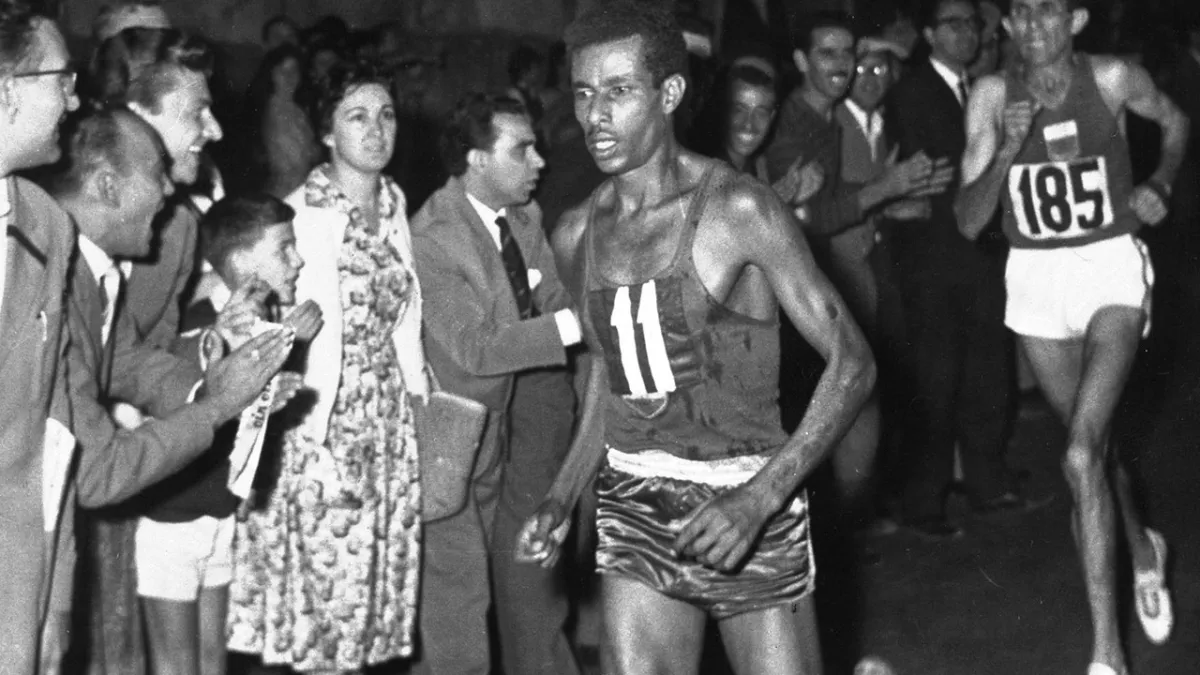 Photo: Abebe Bikila, via www.sportsnet.ca
What has emerged in biographical accounts since his death is a portrait of a man who, in the years after Tokyo, turned increasingly to alcohol as his athletic career wound down and his health declined. A car accident in 1969 left him paralyzed from the waist down. He died in 1973 at 41.
Bikila's struggles with alcohol in his final years are rarely foregrounded in the story the world tells about him, because the barefoot marathon image is simply too powerful to complicate. But his full life — the brilliance, the injuries, the dependency, the early death — is a more honest and ultimately more human story than the highlight reel alone.
5. Marty Liquori — Munich, 1972 (Alternate)
Marty Liquori never won an Olympic medal. That distinction matters here, because his story is about what addiction cost rather than what an athlete achieved in spite of it — and that's a version of this story worth telling too.
Liquori was one of the fastest middle-distance runners in the world in the early 1970s, a legitimate medal contender heading into Munich. He was also, by his own later account, drinking heavily and using recreational drugs during the period when his career should have been peaking. He competed in Munich and didn't medal. He spent years afterward working through addiction before becoming one of the more candid voices in American running about the private lives behind athletic careers.
His story earns its place here because it's the one where the addiction won — at least in Munich — and because his honesty about it later helped crack open a conversation that the sports world had been actively avoiding for decades.
What the Podium Doesn't Show
The easiest thing to do with stories like these is to frame them as inspiration: look how far the human spirit can carry you, even through the darkest valley. And there's truth in that. These athletes did achieve extraordinary things under extraordinary pressure.
But the more honest reading is also the more useful one. These were people in pain, competing in systems — athletic, political, cultural — that had very little interest in their inner lives and enormous interest in their performances. The medal was the point. What it cost the person wearing it was someone else's problem.
Decades later, when the testimony finally emerged, the picture of Olympic glory got more complicated and, in a strange way, more impressive. Not because suffering makes achievement more meaningful, but because knowing the full story makes it harder to watch those podium moments as simple fairy tales.
They weren't fairy tales. They were human beings, doing something almost impossible, for reasons that were never as simple as the scoreboard suggested.