
They Couldn't Play. That's Exactly Why They Could Coach.
There's a comfortable myth in sports that the greatest coaches were once great players — that mastery flows naturally from personal excellence. It's a tidy story. It's also, in a surprising number of cases, completely wrong.
Some of the most celebrated coaching minds in American sports history were, as athletes, forgettable at best and catastrophic at worst. They were cut from rosters, benched by coaches who were too polite to say what everyone already knew, or simply outrun, outmuscled, and outclassed by people who made it look easy.
And then something interesting happened. They stopped trying to be the best player in the room — and started figuring out how to build one.
Here are five Hall of Famers whose playing careers were so unremarkable that their eventual greatness as coaches borders on the miraculous.
1. Tom Landry — The Defensive Back Nobody Remembered
Before Tom Landry became the stone-faced architect of the Dallas Cowboys dynasty — twenty consecutive winning seasons, two Super Bowl titles, a fedora that became as iconic as the star on the helmet — he played defensive back for the New York Giants in the early 1950s.
He was adequate. Not bad. Not good. The kind of player who makes the roster because he's smart and reliable, not because he's exceptional. Landry himself was candid about his limitations. He wasn't fast enough to cover the league's best receivers, and he knew it.
What he did instead was think. Obsessively, systematically, almost academically. He began diagramming plays in his spare time, developing what would become the foundation of the modern 4-3 defensive scheme. He was essentially doing a coach's job while still wearing a player's uniform.
By the time he hung up his cleats, Landry had already mentally moved on. His playing career was a rehearsal for the real work — and the real work would make him one of the most influential figures in NFL history.
What failure taught him: That preparation could compensate for physical limitation. He built a coaching philosophy around intelligence and system over raw talent — because he knew, personally, that raw talent wasn't always enough.
2. Phil Jackson — The Bench Warmer Who Became the Zen Master
Phil Jackson played eleven seasons in the NBA, which sounds impressive until you look at the numbers. He was a backup. A journeyman. A guy who could defend, set a screen, and do the dirty work that statistics don't capture — but who was never, not for a single moment, mistaken for a star.
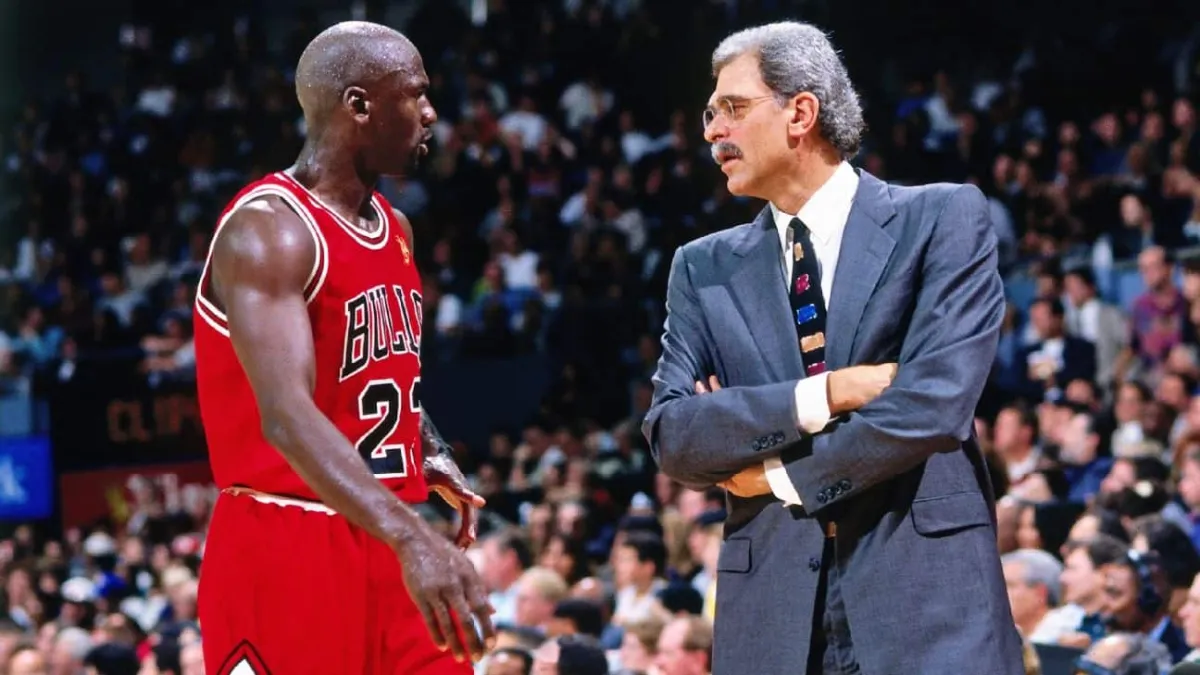 Photo: Phil Jackson, via otakukart.com
His career averages were modest: under seven points per game, under five rebounds. He spent enormous stretches watching basketball from the bench, which, as it turned out, was an extraordinary education.
From the bench, you see things you can't see from the floor. You see how plays develop before they develop. You see why a defensive rotation breaks down three seconds before it actually breaks down. You see the emotional temperature of a team shift in real time.
Jackson absorbed all of it. He also had time to read — voraciously, eclectically — developing the philosophical framework that would eventually make him famous. The triangle offense. The mindfulness practices. The ability to manage enormous egos (Jordan, Pippen, Kobe, Shaq) without destroying the chemistry that made those teams historically great.
Eleven championships as a coach. Zero as a player of consequence.
What failure taught him: That watching carefully is its own form of mastery. And that the player who never quite fits the system often understands it better than anyone.
3. Don Shula — Almost Average, Then Absolutely Legendary
Don Shula played seven seasons in the NFL as a defensive back, primarily for the Cleveland Browns and Baltimore Colts. He was a solid professional — not embarrassing, not exceptional. He intercepted passes, showed up, did his job. Nobody was building a dynasty around him.
When his playing career ended in 1957, Shula was thirty-seven years old (in career terms, at least) and completely unremarkable in the history books. What followed was the most winning coaching career in NFL history: 347 victories, two Super Bowl titles, and the only undefeated season in modern professional football — the 1972 Miami Dolphins.
Shula's coaching genius was rooted in a ferocious attention to detail that, by his own account, came directly from his playing years. He had watched great players up close and understood precisely what separated them from everyone else. He hadn't been one of them, and that gap drove him.
What failure taught him: That talent without discipline is fragile. Shula's teams were famous for preparation, conditioning, and execution — the things a coach controls, not the things a player is born with.
4. Bill Belichick — The Lacrosse Player Who Became Football's Greatest Mind
Bill Belichick played football at Wesleyan University, a Division III school in Connecticut. He was, by every account, a completely unremarkable player — a tight end and center who was listed among the team's players but who left no statistical legacy worth mentioning. He also played lacrosse, which tells you something about where his athletic priorities landed.
He never played a single snap of professional football. He went directly from being a forgettable college player to being an NFL assistant coach, armed with nothing but an obsessive love of the game and a mind that processed football like a chess grandmaster processes the board.
The rest is history that's almost too well-known to recount: six Super Bowl titles with the New England Patriots, a defensive system so sophisticated that NFL offenses spent two decades trying to reverse-engineer it, and a reputation as the most prepared coach in the history of the sport.
Belichick has spoken about the advantage his playing background gave him — not because he was good, but because he wasn't. He approached the game as a student from day one and never stopped.
What failure taught him: That there is no such thing as knowing enough. His coaching staff's preparation is legendary precisely because Belichick never had the luxury of coasting on personal athletic greatness.
5. Pat Summitt — The Player Who Was Good Enough to See What Great Looked Like
Pat Summitt played college basketball at the University of Tennessee at Martin in the early 1970s, and she was genuinely talented — a good player, a hard worker. But the era she played in offered women almost nothing in the way of professional opportunity, and her playing career ended not with fanfare but with a pivot.
 Photo: Pat Summitt, via nellysports.co.uk
She was twenty-two years old when she became the head coach of the Tennessee Lady Vols. Twenty-two. She was still a graduate student. She drove the van to road games herself because there was no budget for a driver.
What followed was the most successful coaching career in the history of women's college basketball: 1,098 wins, eight national championships, and a legacy that fundamentally changed how America understood women's sports.
Summitt's playing experience gave her something essential — she knew, from the inside, what it felt like to work hard in a system that didn't fully respect you. She built her program on the opposite principle: relentless respect for her players' potential, combined with a standard of excellence that brooked absolutely no excuses.
What failure taught her: That limitations imposed from the outside are not the same as limitations from within. She coached her players to understand the difference — and to refuse the former.
The Pattern Nobody Talks About
Look across these five careers and a pattern emerges that the sports world tends to overlook. The coaches who struggled as players often developed something their more gifted peers never needed: a systematic understanding of why things work, rather than simply an intuitive sense that they do.
Great players frequently make poor coaches because excellence came naturally to them. They can't always explain what they do or teach it to someone built differently. The coach who had to fight for every inch of progress — who had to think their way through every limitation — often has a far more transferable skill set.
The bench warmer sees the whole floor. The backup knows what it costs. The cut player understands, better than anyone, how much is at stake.
Sometimes the most important thing a future legend can do is fail — loudly, clearly, and early enough to learn from it.