Grease Under Their Fingernails, Gold in Their Ideas: The Working-Class Inventors Who Built Modern America
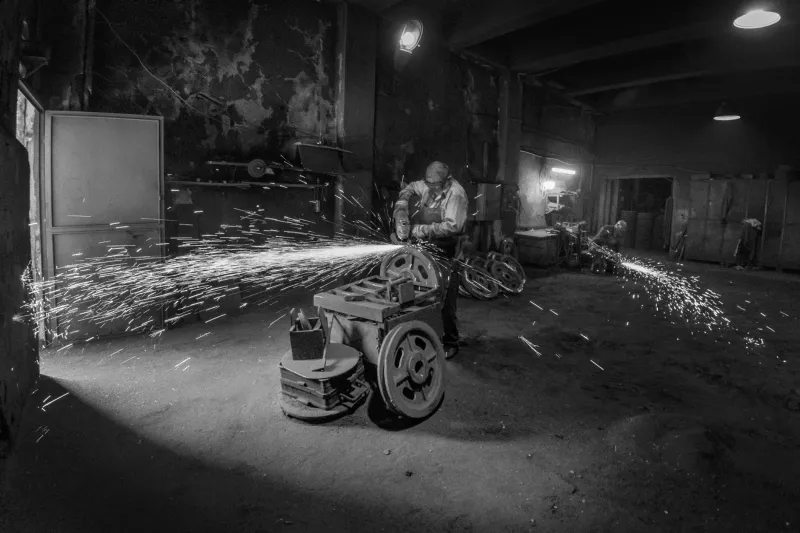
There's a version of American invention history that reads like a highlight reel of polished geniuses — men in well-lit laboratories, surrounded by assistants and investors, solving problems from a comfortable distance. That version is incomplete. Because some of the most consequential ideas in American industrial history didn't come from labs. They came from loading docks. From garbage routes. From the bottom of coal shafts and the back rooms of factories where the ventilation was bad and the pay was worse.
The people who filed those patents didn't look like inventors. Society had already decided what they were. But proximity to unsolved problems has a way of sharpening the mind, and the workers who spent their days elbow-deep in the friction of real life saw solutions that no one sitting behind a desk ever could.
The Man Who Hauled Trash and Held Patents
In the early 1900s, municipal sanitation work was considered one of the least prestigious jobs a man could hold. It was physical, relentless, and largely invisible — the kind of labor that cities depended on and citizens preferred not to think about. Which is exactly why James Dobbins saw something nobody else did.
Working the garbage routes in a mid-sized Midwestern city, Dobbins spent years watching the same inefficiency repeat itself: collection carts that were awkward to load, prone to spilling, and brutal on workers' backs. He wasn't an engineer. He had no drafting table, no formal training, and no industry connections. What he had was a problem he couldn't stop thinking about.
He filed a patent for a redesigned refuse cart mechanism — a loading system that reduced physical strain and dramatically cut collection time per block. The patent was granted. The design was quietly adopted. Dobbins went back to his route.
His story isn't unique. It's part of a pattern that runs through American labor history like a seam through rock: workers who encountered the same broken thing every single day until they couldn't help but fix it.
The Dockworker's Problem Nobody Else Had
Loading cargo by hand is one of the oldest professions on earth. It is also, historically, one of the most dangerous. In the late nineteenth century, American port workers were losing fingers, hands, and lives to equipment that hadn't meaningfully changed in generations.
One dockworker in Baltimore — a man who had spent fifteen years on the waterfront and had the injury record to prove it — became obsessed with a specific problem: the way rope-and-pulley systems failed under uneven weight distribution. He understood it not through physics textbooks but through his own shoulders and the near-misses he'd watched accumulate over a decade and a half.
His solution, a modified tensioning mechanism that equalized load distribution during heavy lifts, was patented in 1897. Maritime historians have since traced versions of that principle through generations of cargo equipment. The dockworker himself was never celebrated for it. His name appeared once, in the patent record, and then faded back into the anonymity of the waterfront.
That anonymity is itself part of the story. These inventors weren't invisible because their ideas were small. They were invisible because the world had already filed them under a different category.
The Farmhand Who Fixed the Machine That Fed America
Agricultural mechanization transformed the American food system in the nineteenth and early twentieth centuries, but the machines that drove that transformation were imperfect, expensive to repair, and frequently prone to the kind of catastrophic failure that could destroy a harvest.
Farmhands — the men who operated those machines from dawn to dusk — understood their limitations in a way that manufacturers simply didn't. One such worker, employed on a large grain operation in Kansas, spent two growing seasons documenting a recurring failure point in a widely used threshing mechanism. When he brought the problem to his employer, he was told it was a manufacturer's issue and not his concern.
So he made it his concern on his own time.
Working evenings in a shed behind the bunkhouse, using scavenged parts and hand tools, he developed a modification that addressed the failure point directly. He filed the patent himself, paying the filing fee out of his seasonal wages. The patent was granted in 1911. A regional agricultural equipment company licensed the modification within two years.
He never stopped being a farmhand. But somewhere in a government archive, his name sits next to an idea that kept grain moving across the country for decades.
Why Proximity Is the Greatest Credential
What these stories share isn't genius in the Hollywood sense. None of these men were prodigies. None of them had access to capital or connections. What they had was something more powerful than either: they lived inside the problem.
Innovation, when you strip away the mythology, is often just sustained irritation directed at something that doesn't work. The people best positioned to feel that irritation are the ones who encounter the broken thing every day, who feel it in their hands and backs and schedules, who can't escape it by going home to a different kind of life.
White-collar inventors solve problems they've been assigned. Working-class inventors solve problems they can't avoid.
The US patent system, whatever its flaws, was theoretically open to anyone from its earliest days. Abraham Lincoln — himself a patent holder — spoke about the system as a democratizing force, a way of rewarding ingenuity regardless of station. The reality was messier. Filing a patent cost money that many workers didn't have. Navigating the application process required literacy and time that twelve-hour shifts didn't always allow. And even when patents were granted, the legal and commercial machinery needed to profit from them was largely inaccessible to people without capital.
 Photo: Abraham Lincoln, via c8.alamy.com
But some got through anyway. And the ones who did left a record.
What the Patent Office Quietly Knows
Historians who have spent time combing through late nineteenth and early twentieth century patent records have found a consistent thread: a meaningful number of applications list occupations that the broader culture associated with manual labor rather than intellectual achievement. Janitors. Coal haulers. Textile workers. Slaughterhouse employees.
These weren't people who stumbled into invention. They were people who had been solving problems quietly for years before they ever put pen to paper. The patent application was often the last step in a long, private process — not the beginning of an idea but the formal acknowledgment of one that had already been tested and refined through lived experience.
The gap between how these inventors were perceived and what they were actually doing is one of the great untold stories of American economic history. The country benefited from their ideas. It just rarely said so.
The Unlikely Made, Every Day
There's something clarifying about these stories. They push back against the comfortable narrative that innovation flows downward from the educated and the powerful to the rest of us. They suggest instead that the most durable ideas often flow upward — from the people closest to the problem, through whatever cracks the system left open, into a world that used the invention while forgetting the inventor.
The garbage collector with grease under his fingernails. The dockworker with a decade of near-misses catalogued in his memory. The farmhand working by lantern light in a shed.
They built things. America used them. And somewhere in the public record, if you know where to look, their names are still there — waiting for someone to notice.