Photo: Australian National Maritime Museum on The Commons, No restrictions, via Wikimedia Commons
She Drew the Bridges They Told Her She'd Never Build
Somewhere in the American Midwest, there is a bridge you have probably crossed without thinking about it. It carries tens of thousands of vehicles a year. It has stood for decades. Its load calculations are clean, its span elegant, its tolerances precisely what they need to be.
Its designer was a woman who, by the official record, had no business designing it.
Her name was Eleanor Marsh. And her story sits at the uncomfortable intersection of injustice, ingenuity, and a question that American professional culture has never fully resolved: What does it mean to be legitimate?
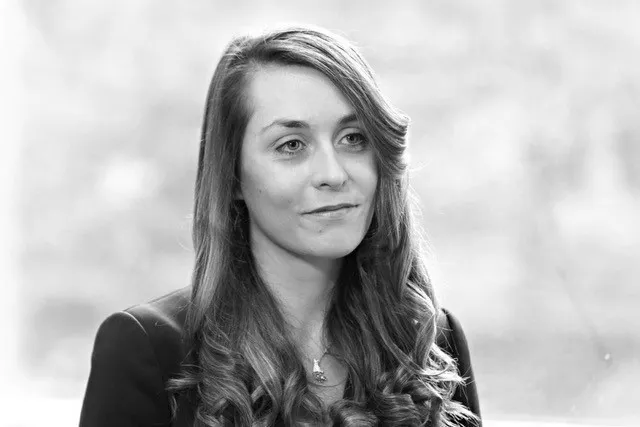 Photo: Eleanor Marsh, via www.3pb.co.uk
The Doors That Wouldn't Open
Eleanor grew up in Cincinnati in the 1930s, the daughter of a structural ironworker who came home every evening smelling of steel and spent his weekends drawing. Not art — structures. Load-bearing walls. Bridge trusses. The geometry of things that had to hold.
She absorbed it the way other kids absorbed baseball statistics. By the time she was in high school, she was solving structural problems in her spare time, filling notebooks with calculations that her father, who had a sixth-grade education and an engineer's intuition, checked and confirmed.
When she applied to engineering programs in the late 1940s, the responses were uniform. Some rejections were polite. Some were not. One admissions officer at a prominent Midwestern university reportedly told her, without apparent irony, that the program was "not equipped to accommodate the social complications" of female students.
She applied to four programs. She was rejected by all four.
What happened next depends on which version of Eleanor's story you find most credible — and that ambiguity is, in some ways, the most interesting part.
The Paper That Got Her In
By 1951, Eleanor had taken every correspondence course available, audited lectures at a local college by sitting in the back and saying nothing, and spent three years working as a bookkeeper at a civil engineering firm in Cincinnati — a job that gave her access to blueprints, project files, and the daily working vocabulary of professional engineering.
She knew the work. She simply didn't have the paper that said she was allowed to know it.
In 1952, she applied for a junior drafting position at a mid-sized infrastructure firm in Columbus, Ohio. The application required a transcript demonstrating coursework in structural mechanics and materials science. Eleanor submitted one.
The transcript was not entirely fabricated. It was, by most accounts, a document that blended genuine coursework — her correspondence credits, her audited classes — with enough formal-looking detail to pass a cursory review. Whether the firm's hiring manager looked closely or simply assumed no woman would misrepresent her qualifications is a question that history has left unanswered.
She got the job.
The Quiet Outperformance
The drafting pool at the firm in 1952 was almost entirely male, almost entirely credentialed, and almost entirely uninterested in the quiet woman at the corner desk who seemed to finish her assignments faster than anyone else and then asked for more.
Eleanor's early work was drafting — translating engineers' sketches into precise technical drawings. She was extraordinarily good at it. But she was also doing something her colleagues weren't: annotating. Quietly, in pencil, in the margins of her own working copies, she was flagging calculation errors, suggesting load adjustments, identifying stress points that the credentialed engineers above her had missed.
For the first year, she showed these notes to no one. Then, carefully, she began sharing them with the senior draftsman she trusted most — a man named Harold Kessler who had the professional confidence to bring her corrections upward without feeling threatened by them.
"She'd hand me a sheet," Kessler reportedly told a colleague years later, "and I'd look at it and think, this is better than what the engineers gave us. And she'd just shrug and say she was probably wrong."
She was not wrong. The corrections held up. The errors she flagged were real.
Within three years, Eleanor was functioning as a de facto structural consultant on several of the firm's projects, though her title remained junior draftsman and her salary reflected it.
The Bridges
The infrastructure boom of the 1950s gave Eleanor's firm more work than it could easily manage. Federal highway funding was flooding into states across the country, and firms that could deliver reliable structural designs on tight timelines were in high demand.
Eleanor's contribution to several projects during this period is documented — partially — in the firm's internal records, which were donated to an Ohio historical archive in the 1990s. Her name appears in project notes, in internal memos, and in the handwritten calculation sheets that accompanied final designs. In the official project documentation submitted to state agencies, her name does not appear.
At least three bridge structures built in Ohio and Indiana during the late 1950s bear her design fingerprints in ways that engineering historians who have studied the archive have found difficult to attribute to anyone else. The load distribution models are distinctive. The approach to deck drainage reflects a solution she had proposed in an internal memo. The tolerance calculations in the foundation specifications match methods she had developed and documented.
Those bridges are still standing.
The Question That Won't Sit Still
Eleanor's story was brought to wider attention in the early 2000s by a historian at Ohio State who was researching women in mid-century American engineering. The historian, who spent three years with the firm's archive, was careful in her conclusions — careful because the story raises questions that don't have clean answers.
Eleanor did misrepresent her credentials. That is not in dispute. In a professional world governed by licensure and accountability, that matters. Structural failures kill people. The systems that require engineers to demonstrate competence before they're trusted with public safety exist for real reasons.
And yet. The system that made misrepresentation Eleanor's only viable option also existed for real reasons — reasons that had nothing to do with public safety and everything to do with who was considered capable of professional thought.
She was excluded not because she lacked the knowledge. She was excluded because of her gender. The credential she fabricated was not a substitute for competence — it was a substitute for the opportunity to demonstrate competence through the channels that had been deliberately closed to her.
The bridges held. The math was right. The structures she helped design are carrying traffic today.
What Legitimacy Actually Means
Eleanor Marsh never held a professional engineering license. She left the Columbus firm in 1961, married, moved to Indiana, and spent the rest of her working life teaching mathematics at a community college — a job she was, by all accounts, extraordinary at.
She rarely talked about the drafting years. When she did, she was matter-of-fact about what she had done and why. "I knew the work," she told the Ohio State historian in one of their recorded interviews, conducted when Eleanor was in her seventies. "I knew it better than most of the men they hired with their proper degrees. I needed a door. There wasn't one. So I made one."
The historian's paper on Eleanor's career generated modest academic attention and a brief flurry of interest from engineering professional organizations, some of which used her story as a case study in discussions about credentialing reform and diversity in STEM fields.
None of them put her name on the bridges.
But the bridges are still there. And every time someone crosses one without thinking about it — without wondering who calculated the load, who drew the span, who made sure the math was right — they are, in some small and unknowing way, trusting Eleanor Marsh.
She earned that trust the hard way. She earned it the only way the system left open to her.
And the bridges held.