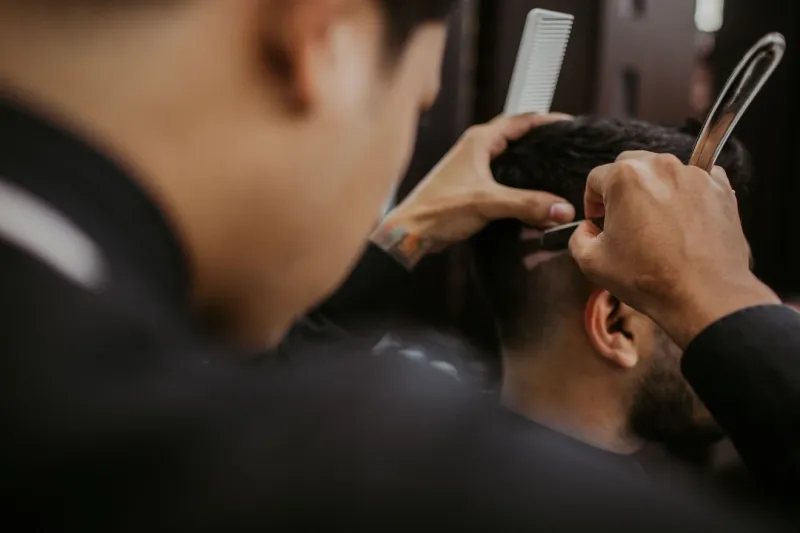
Calvin Merritt didn't set out to change medicine. He set out to give people a clean fade and send them home looking sharp. But somewhere between the clippers and the conversation, he started noticing things.
It was the skin. Specifically, the patches of it on the back of necks, behind ears, along hairlines — places people almost never look at themselves, places that rarely get flagged at a routine checkup, but places that a barber sees, up close, under bright light, every single day.
The View from Behind the Chair
Merritt ran a one-chair shop in rural North Carolina for over two decades. His clientele was loyal, multigenerational, and mostly outdoor workers — farmers, construction crews, men who spent their days under a Southern sun without thinking twice about it. By his own account, he wasn't a worrier. He wasn't looking for problems.
But problems have a way of showing up when you're paying attention.
Over a stretch of about four years in the mid-1990s, Merritt began noticing a pattern. Several of his regular clients had small, irregular spots near their hairlines — spots that didn't look quite right to him, though he couldn't have told you exactly why. Some were dark and asymmetrical. Some had edges that seemed to bleed into the surrounding skin. A few had changed between visits.
He wasn't a doctor. He knew that. But he was also someone who had stared at thousands of necks, and something in his gut said these weren't ordinary age spots or sun freckles.
So he did what curious people do when they have no formal training but a lot of determination: he started writing things down.
A Notebook That Nobody Asked For
Merritt kept a simple spiral notebook behind his station. He sketched the spots as best he could, noted their locations, recorded the client's age and occupation, and wrote down whether anything had changed since the last visit. He was careful not to alarm anyone — he'd simply mention, as casually as he could manage, that they might want to have a particular spot looked at by their doctor.
Not everyone listened. Some did.
Of the clients he flagged over those four years, three were eventually diagnosed with melanoma — the most dangerous form of skin cancer, and one that, when caught early, has a survival rate that drops dramatically the longer it goes undetected. Two of those three caught it at a stage where treatment was still highly effective.
Merritt didn't announce this. He didn't hold a press conference. He just kept cutting hair and kept taking notes.
What changed things was a local health fair in 1998, where a dermatologist named Dr. Angela Foss was running a free skin screening booth. Merritt walked over during his lunch break, not as a patient, but with his notebook. He wanted to know if he was seeing what he thought he was seeing.
Foss later described that conversation as one of the most surprising of her career.
Proximity as a Diagnostic Tool
"He had documented locations, descriptions, changes over time," Foss said in a 2004 interview with a regional health journal. "The methodology wasn't clinical, but the instinct was sound. He was tracking exactly the right variables."
What Merritt had stumbled into — without knowing the terminology — was something dermatologists call the "ugly duckling" sign: the idea that a suspicious lesion often looks different from the surrounding spots on a person's skin. He couldn't name it, but he could see it. And more importantly, he saw it repeatedly, on the same clients, over time — something a one-time clinical exam almost never captures.
Foss connected Merritt with a research team at a university hospital that was studying barriers to early melanoma detection in rural communities. The team was already aware that men in the American South were significantly underscreened for skin cancer — they tended to avoid doctors, worked outdoors without protection, and often had no one in their lives flagging potential warning signs.
Except, in some cases, their barber.
The research that followed, which Merritt contributed to as a community informant rather than a co-author, helped support what has since become a small but growing movement: the idea that barbershops and beauty salons could serve as informal frontlines in public health outreach. Studies have since explored similar models for blood pressure screening, diabetes awareness, and mental health conversations — all built on the same premise Merritt demonstrated without a grant or a graduate degree.
What Credentials Can't Replace
There's a temptation to frame this story as a feel-good anomaly — the lucky amateur who got it right. But that framing misses the point. Merritt wasn't lucky. He was attentive, and he was consistent, and he was in a position that no dermatologist could replicate: seeing the same people, in the same light, across years of visits, in a setting where they were relaxed and trusting.
Dermatologists are extraordinarily skilled. But they see patients episodically, in clinical settings, often without the longitudinal familiarity that makes change visible. Merritt had something no degree program teaches: continuity.
He retired in 2011. His notebook, the original spiral one, was donated to the university research team. It sits in a file somewhere, full of careful sketches and handwritten observations, made by a man who had no business being right — and was right anyway.
Some of the most important things in medicine have been noticed first by people who weren't supposed to be looking. Calvin Merritt just had the good sense to write it down.