He Mopped Floors for Thirty Years. His Inventions Now Sit Behind Museum Glass.
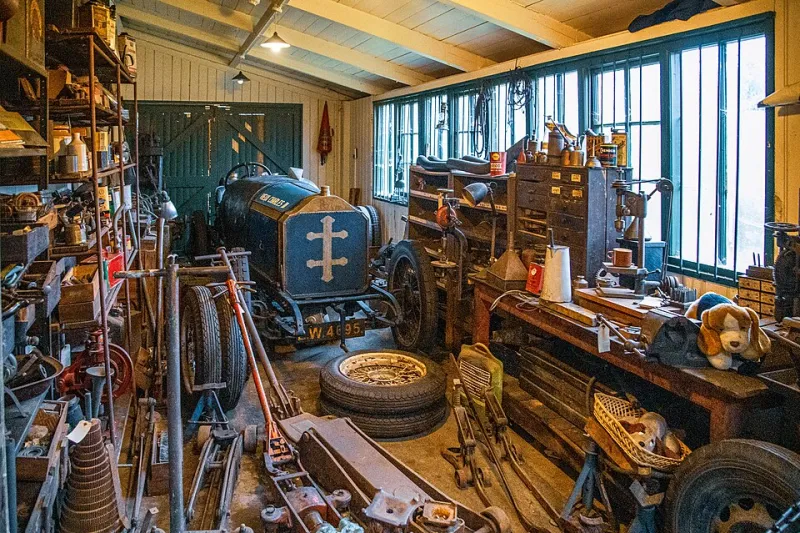
Photo: Michael Gaylard, CC BY 4.0, via Wikimedia Commons
The dumpster behind the First Federal Building in downtown Cincinnati held a lot of things over the years: dead fluorescent tubes, busted copy machines, a waterlogged typewriter that someone had thrown out with real violence. To the cleaning crews who worked the night shift, it was just garbage. To Ray Delgado, it was a supply depot.
Delgado cleaned offices for thirty-one years. He also holds eleven U.S. patents, and one of his devices — a compact fluid-regulating valve that quietly ended up in dialysis machines across the country — is now part of the Smithsonian's permanent collection of American invention. He never took a single college engineering course.
The Education of the Night Shift
Delgado came to cleaning the way a lot of people do: he needed the work. A high school dropout from Price Hill whose father died when he was sixteen, he took the janitorial job at twenty-two because it paid the rent and, crucially, left his days free.
What he discovered was that a commercial building after midnight is a kind of unofficial engineering school. "People throw away the most incredible things," he told a local reporter in 1998, near the end of his cleaning career. "Half the time, the thing that's broken is one part away from working. So you learn what every part does."
He stripped abandoned copy machines for motors. He pulled precision switches out of scrapped medical equipment that a tenant had dumped during an office move. He kept a notebook — dozens of them, actually — filled with sketches of problems he noticed during his rounds: the leaking break-room faucet, the elevator doors that closed too fast for the man in 4B who used a walker.
That's the thing people miss about Delgado's story. He wasn't inventing in the abstract. He was inventing against a checklist of small, daily frictions that credentialed engineers in suburban labs never had to think about.
The Garage as an Institution
There's a reason the American garage occupies its own mythology. The garage is where you're allowed to fail cheaply. Nobody watches. Nobody asks for a progress report. The garage doesn't care that you don't have a degree.
Delgado's two-car garage in Western Hills became exactly that kind of space. He built a fluid valve there in the mid-1980s after watching a neighbor come home exhausted from dialysis treatments, complaining about how unreliable the flow regulators were. Delgado spent three years on the problem — carving test housings out of scrap, blowing fuses, starting over. He was forty-nine when the patent was granted.
Here's what's worth sitting with: the valve worked because Delgado didn't know it wasn't supposed to work that way. Trained engineers had optimized around certain manufacturing assumptions. Delgado, working with salvaged parts, had optimized around the only thing he understood — the neighbor slumped in his recliner. His design was cruder and cheaper and, it turned out, more durable.
A small medical supply company licensed the patent in 1991. It wasn't a fortune, but it was enough that Delgado could have quit cleaning. He didn't, not for another six years. "The building's where the problems are," he said. "You want to take my problem-finder away?"
Obscurity as a Competitive Advantage
We tend to frame outsider inventors as victims of a system that overlooked them. There's truth in that. But there's a second, less comfortable reading: obscurity gave Delgado room. No investors demanding quarterly breakthroughs. No colleagues to embarrass himself in front of. No institutional consensus telling him which approaches were dead ends.
Freedom to experiment has always been rationed in this country, and it's usually rationed by credential. Delgado simply found a loophole — a mop bucket on one end, a soldering iron on the other.
He died in 2014, at seventy-nine, in the same house. The Smithsonian acquired the valve, two of his notebooks, and his original workbench the following year. Museum visitors walk past it now, most of them unaware that the man who built it spent decades being invisible in the most literal sense — pushing a cart through darkened hallways while the city slept.
The garage didn't just make Ray Delgado an inventor. It made him the kind of inventor America keeps forgetting it produces — and keeps needing.