He Dropped Acid, Surfed Every Morning, and Won the Nobel Prize: The Wildest Mind in Modern Science
He Dropped Acid, Surfed Every Morning, and Won the Nobel Prize: The Wildest Mind in Modern Science
Kary Mullis once said that the best ideas don't come from sitting in a lab staring at a whiteboard. They come sideways — unexpected, almost accidental, arriving in the space between what you were thinking about and what you forgot to worry about.
He would know.
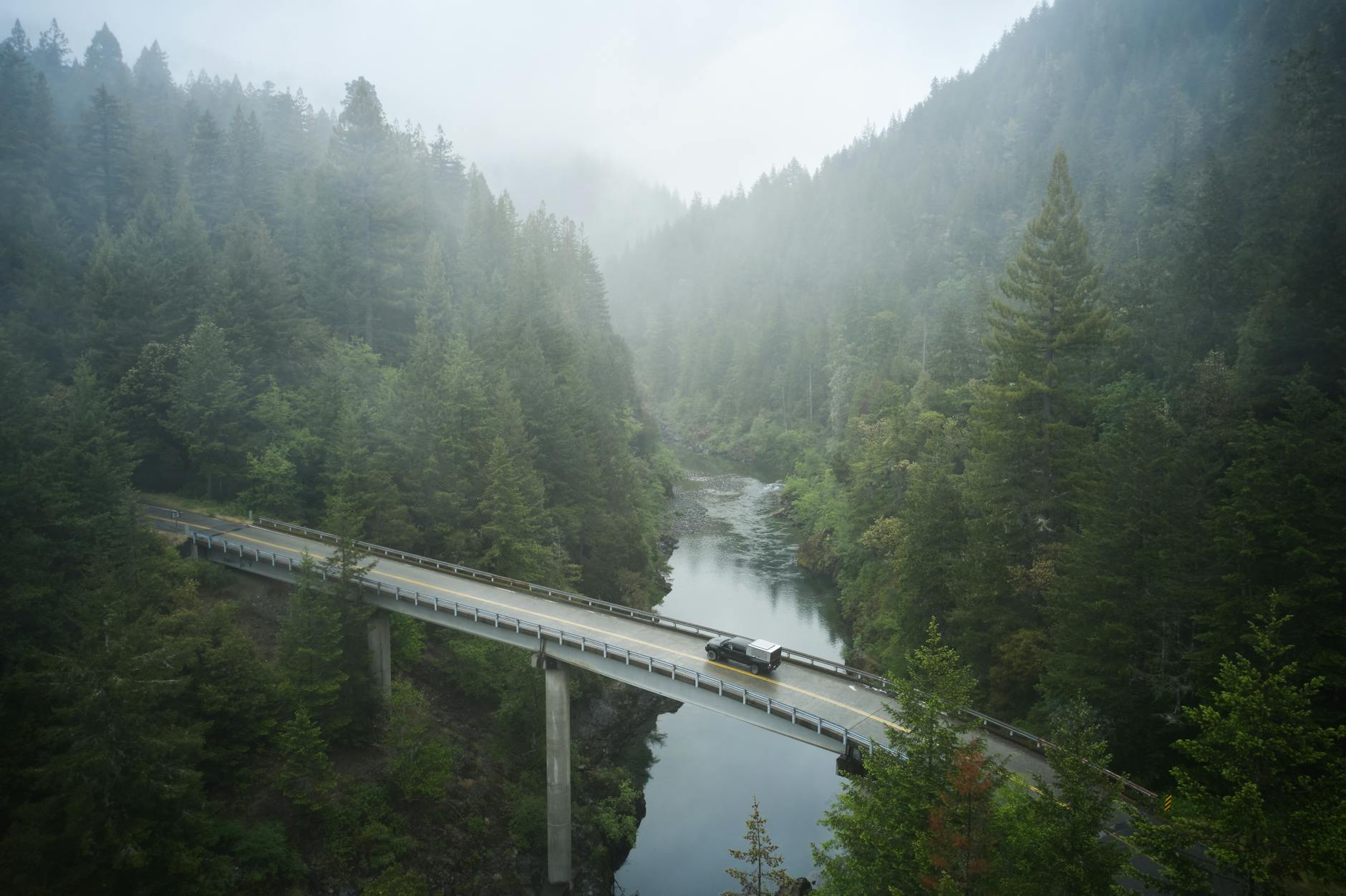
In the spring of 1983, Mullis was driving north on Highway 128 through the redwood forests of Mendocino County, California, his girlfriend dozing in the passenger seat, the dark trees rushing past on either side. His mind was wandering the way it tended to do — loose, associative, unbothered by the rules of formal scientific inquiry. And then, somewhere between mile markers, it hit him. A technique so elegant, so almost embarrassingly simple, that he would later struggle to understand why no one else had thought of it first.
He pulled over and wept.
That roadside epiphany — the invention of polymerase chain reaction, or PCR — would eventually reshape criminal justice, revolutionize disease diagnosis, make the COVID-19 test possible, and earn Mullis the Nobel Prize in Chemistry in 1993. It is, without exaggeration, one of the most consequential scientific discoveries of the twentieth century.
And it came from a man who spent his lunch breaks surfing.
Growing Up Restless in Rural South Carolina
Kary Banks Mullis was born in 1944 in Lenoir, North Carolina, and grew up in Columbia, South Carolina, where his early scientific instincts were less "future Nobel laureate" and more "neighborhood hazard." As a teenager, he built his own rockets using potassium nitrate and sugar, launching frogs into the upper atmosphere and recovering them alive — a detail he recounted with obvious pride for the rest of his life.
The curiosity was real. The respect for authority was not.
He scraped through his undergraduate chemistry degree at Georgia Tech with grades that suggested a man doing the minimum required to stay enrolled. He was bored by rote learning, allergic to academic performance for its own sake, and far more interested in the questions that didn't have answers yet. He eventually landed at UC Berkeley for his PhD in biochemistry, where the culture of intellectual freedom suited him considerably better.
Berkeley in the late 1960s was not, to put it mildly, a place that discouraged unconventional thinking. Mullis fit right in. He experimented freely — with ideas, with substances, with the outer edges of what a scientist was supposed to look like. He once wrote a paper on the cosmological implications of time reversal. His dissertation advisor reportedly had to talk him out of several tangents that had nothing to do with his actual degree.
He graduated anyway. The mind, however unruly, was clearly exceptional.
The Man the Lab Couldn't Contain
After a stint writing fiction — yes, fiction — and a brief detour into running a bakery, Mullis eventually landed at Cetus Corporation, a biotech startup in Emeryville, California, in 1979. His job was synthesizing short strands of DNA. It was technical, somewhat repetitive work, and Mullis found large portions of it tedious.
What he did not find tedious was the underlying puzzle of how DNA worked — how it copied itself, how errors crept in, how the machinery of life replicated information with such staggering fidelity. He thought about these questions constantly, often in ways that had no immediate practical application and that made his supervisors mildly nervous.
His lifestyle did not exactly scream "future Nobelist" either. He surfed regularly on the Northern California coast. He had a cabin in Mendocino where he retreated on weekends. He was, by his own cheerful admission, a frequent user of LSD throughout his formative years — something he credited, controversially but consistently, with loosening the mental frameworks that might otherwise have kept him inside the lines.
"What if I had not taken LSD ever?" he wrote in his memoir, Dancing Naked in the Mind Field. "I could have easily not done it... and it could have been a dull, stupid life."
The scientific establishment was not sure what to do with him. His colleagues at Cetus found him brilliant and infuriating in roughly equal measure.
The Highway and the Epiphany
The problem Mullis had been turning over in his mind was deceptively simple: how do you make more of a specific piece of DNA quickly and reliably? At the time, isolating and copying a particular genetic sequence was slow, expensive, and technically brutal. It required equipment most labs didn't have and expertise that took years to develop.
What if, Mullis thought, you could just use the cell's own copying machinery — the enzyme DNA polymerase — and direct it to repeat a specific section over and over again, doubling it with each cycle until you had millions of copies from a single original?
The idea seems obvious in retrospect. That's the hallmark of a truly great insight. But in 1983, it was not obvious at all. Other scientists had worked with the same tools and the same knowledge and had never assembled the pieces in this way. Mullis, driving through the dark redwoods on that Friday night in April, put them together almost effortlessly.
He pulled over. He did the back-of-envelope math. It worked. He woke his girlfriend to tell her. She went back to sleep.
The next months were a strange kind of purgatory. Mullis ran the experiments, refined the method, tried to get his colleagues as excited as he was. Many were skeptical. A few thought he was missing something obvious, that there had to be a reason nobody had done this before. There wasn't. PCR worked exactly as he had imagined it on that highway, and when Cetus filed the patents and the scientific community finally caught up, the reaction was seismic.
The Prize and the Paradox
The Nobel Committee awarded Mullis the 1993 Chemistry Prize jointly with Canadian chemist Michael Smith. The ceremony in Stockholm was, by all accounts, a slightly surreal affair — Mullis was never entirely at home in formal settings, and he remained, even at the height of his fame, deeply suspicious of institutional science and the conformity it demanded.
He spent the years after the Nobel writing, speaking, surfing, and saying things that made his former admirers deeply uncomfortable — including public skepticism about the link between HIV and AIDS, and later, climate science. His defenders argued that the same radical independence that made him a genius also made him a contrarian who couldn't always tell the difference between challenging orthodoxy productively and denying evidence inconveniently. His critics were less generous.
Kary Mullis died in August 2019 at the age of 74. Less than a year later, the PCR test he invented became the backbone of the global COVID-19 testing effort — deployed billions of times across every country on earth to track a pandemic he never lived to see.
The legacy is complicated, as the legacies of genuinely original people tend to be. But the core of the story remains stubbornly inspiring: the man who changed medicine forever was not the most disciplined scientist in the room, not the most credentialed, not the most conventional. He was the one who refused to stop asking the questions that didn't have answers yet — and who was loose enough, strange enough, and free enough to hear the answer when it finally arrived.
Somewhere on a dark California highway, at a speed limit of 55 miles per hour, the unlikely was made.